Category | Quality Management
Last Updated On 19/02/2026
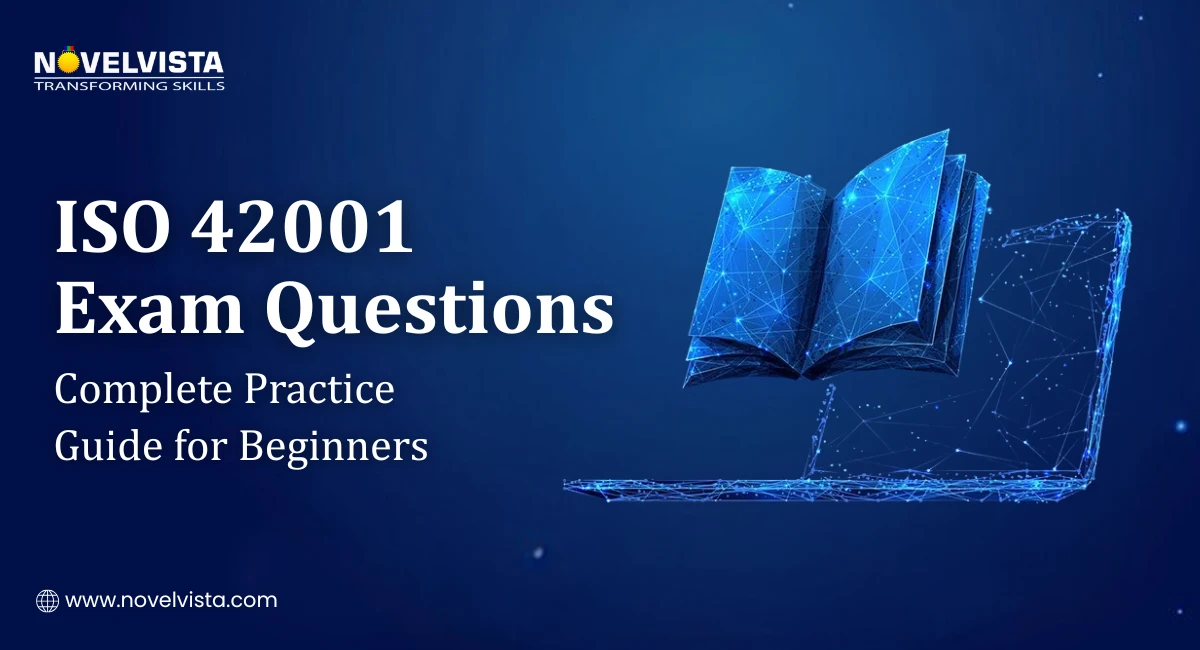
Artificial Intelligence is transforming industries at an unprecedented pace. According to recent industry reports, over 80% of enterprises now use AI in at least one core business function. At the same time, global AI regulations are tightening, and organizations are under pressure to prove that their AI systems are transparent, accountable, and risk-managed.
That’s where ISO/IEC 42001 comes in — the world’s first international standard for AI Management Systems (AIMS).
If you're preparing for certification, one thing matters most: practicing the right ISO 42001 exam questions.
But who is this guide for?
Beginners entering AI governance or compliance
IT professionals transitioning into AI risk roles
Auditors and consultants preparing for AI management system certification
Compliance officers aligning with AI regulations
In this blog, you’ll find a structured collection of ISO 42001 exam questions and answers covering AI governance questions, AI risk management questions, AI management system questions, and AI compliance exam questions — designed specifically for beginners.
Let’s begin.
Below are 40 ISO 42001 Sample Questions designed to closely mirror the actual exam pattern. These questions will help you test your readiness, understand key concepts, and become familiar with the exam question style.
(You can also download these ISO 42001 Lead Auditor exam questions and answers PDF for offline revision and last-minute preparation.)
Answer:
The primary objective is to establish, implement, maintain, and continually improve an AI management system that ensures responsible, ethical, and risk-managed use of AI systems.
Answer:
Top management is responsible for defining and approving the AI policy, demonstrating leadership and commitment — a common theme in AI governance questions.
Answer:
An AI Management System is a structured framework that governs AI development, deployment, monitoring, and continual improvement in alignment with risk and compliance requirements.
Answer:
The first step is identifying AI-related risks, including bias, security vulnerabilities, ethical concerns, and operational failures — a frequent topic in AI risk management questions.
Answer:
Risk-based thinking means proactively identifying, analyzing, and treating risks before they negatively impact stakeholders or compliance obligations.
Answer:
The Leadership clause requires top management to establish accountability, define roles, and ensure AI governance is integrated into business strategy.
Answer:
Documented information includes policies, procedures, risk assessments, records, and evidence required to demonstrate compliance — often tested in AI compliance exam questions.
Answer:
Defining scope ensures clarity about which AI systems, processes, and organizational units are covered under the AI management system.
Answer:
AI lifecycle management covers planning, development, validation, deployment, monitoring, and decommissioning of AI systems.
What should an organization do if bias is detected in an AI model?
Answer:
The organization must conduct a risk reassessment, implement corrective actions, document findings, and monitor improvements — typical in AI risk management questions.
Answer:
Internal audits evaluate whether the AI management system conforms to ISO requirements and is effectively implemented.
Answer:
Corrective action involves identifying the root cause of a nonconformity and taking steps to prevent recurrence — commonly tested in AI compliance exam questions.
Answer:
AI governance focuses on oversight and accountability, while AI operations focus on implementation and execution within the AI management system.
Answer:
Continual improvement refers to ongoing enhancement of the AI management system based on audit findings, monitoring results, and changing regulatory requirements.
Answer:
Stakeholder analysis helps identify expectations and regulatory requirements that impact AI governance and compliance.
Answer:
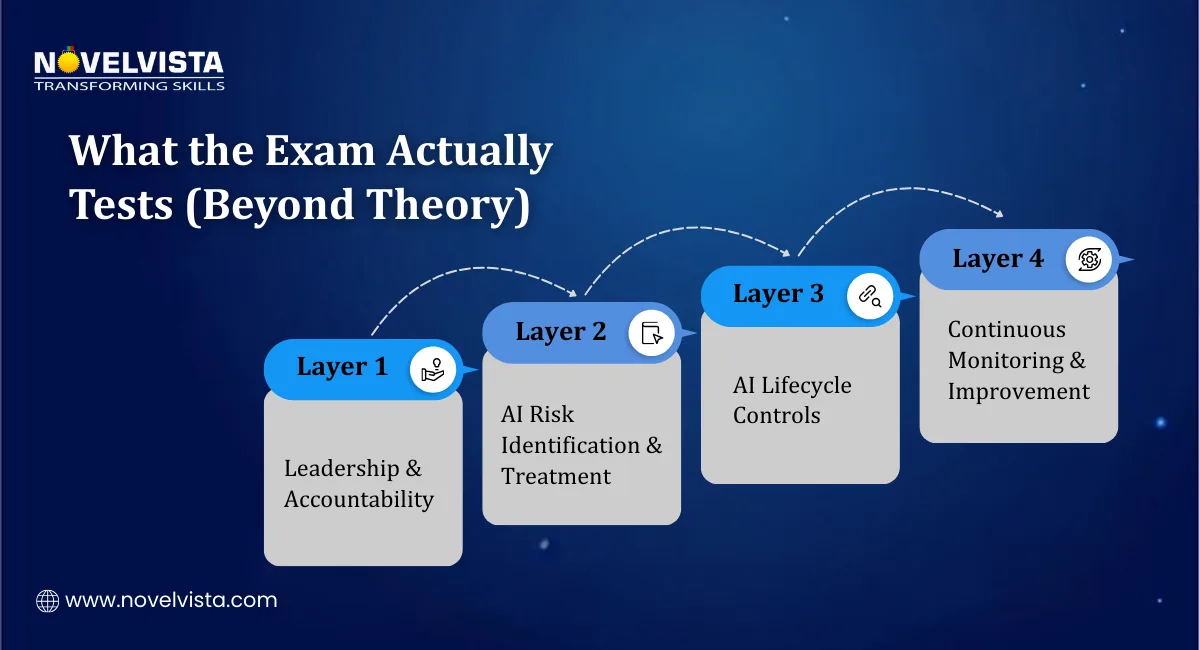
They test knowledge of regulatory alignment, documentation, internal audits, corrective actions, and evidence-based controls.
Answer:
Risk treatment involves selecting and implementing controls to mitigate, transfer, avoid, or accept identified AI risks.
Answer:
Monitoring ensures that AI systems remain accurate, fair, secure, and aligned with governance requirements.
Answer:
Top management holds ultimate accountability, even if operational tasks are delegated — a recurring concept in AI governance questions.
Answer:
No. ISO 42001 exam questions focus on governance, risk management, documentation, and compliance — not AI programming.
Answer:
To provide evidence that AI governance processes, risk assessments, and controls are implemented and maintained.
Answer:
Auditors assess whether the AI management system conforms to ISO 42001 requirements and identify areas for improvement.
Answer:
Nonconformity occurs when a requirement of the AI management system is not fulfilled.
Answer:
Corrective action eliminates the root cause of nonconformities to prevent recurrence.
Why is monitoring AI systems necessary?
Answer:
Monitoring ensures continued compliance, risk control effectiveness, and performance reliability.
Answer:
Risk mitigation reduces risk impact or likelihood, while risk acceptance acknowledges the risk without additional control measures.
Answer:
They focus on documentation, audits, regulatory alignment, and proof of implemented controls.
Answer:
Initiate risk reassessment, investigate root causes, implement corrective actions, and document the response.
Answer:
Clear role definitions ensure accountability and effective AI governance implementation.
Answer:
It involves informing relevant parties about AI risks, performance, and governance measures.
Answer:
Conduct a risk assessment to identify bias sources and implement mitigation measures.
Answer:
Operational control and documented information requirements within the AI management system.
Answer:
Continual monitoring and improvement — a key area in AI risk management questions.
Answer:
A documentation nonconformity affecting compliance and traceability.
Answer:
Top management holds ultimate accountability under AI governance requirements.
Answer:
Lifecycle management covers planning, design, development, validation, deployment, monitoring, and retirement of AI systems.
Answer:
To enhance AI governance processes and adapt to evolving risks and regulations.
Answer:
Making governance and risk decisions based on documented analysis and performance data.
What is meant by “interested parties” in ISO 42001?
Answer:
Interested parties include customers, regulators, employees, partners, and users affected by AI systems.
70+ curated ISO 42001 exam questions Real-world AI governance scenarios Auditor-focused practice format
Preparing for ISO audit questions and answers doesn’t require deep technical AI expertise it requires clarity in governance, structured risk management thinking, and understanding how an AI management system operates.
By practicing these AI governance questions, AI risk management questions, AI management system questions, and AI compliance exam questions, beginners can build strong conceptual foundations and confidently approach certification.
AI is reshaping the world and professionals who understand responsible AI governance will lead that transformation. Keep practicing ISO 42001 exam questions, focus on risk-based thinking, and approach every scenario from a governance perspective. Explore the latest ISO 42001 Salary Guide to understand earning potential, role-based pay trends, and career growth opportunities in AI governance and compliance.
You’re not just preparing for an exam — you’re preparing to manage AI responsibly.
Join NovelVista’s ISO/IEC 42001 Lead Auditor Certification Training and gain hands-on expertise in AI management system audits, real-world insights, and globally-recognized credentials. Designed for IT professionals, auditors, compliance leaders, and aspiring AI governance specialists, this course equips you to confidently lead ISO 42001 audits and drive AI excellence in your organization.
Start your ISO 42001 Lead Auditor journey today!
Author Details

Course Related To This blog
ISO 42001 Lead Auditor
Confused About Certification?
Get Free Consultation Call
Stay ahead of the curve by tapping into the latest emerging trends and transforming your subscription into a powerful resource. Maximize every feature, unlock exclusive benefits, and ensure you're always one step ahead in your journey to success.